
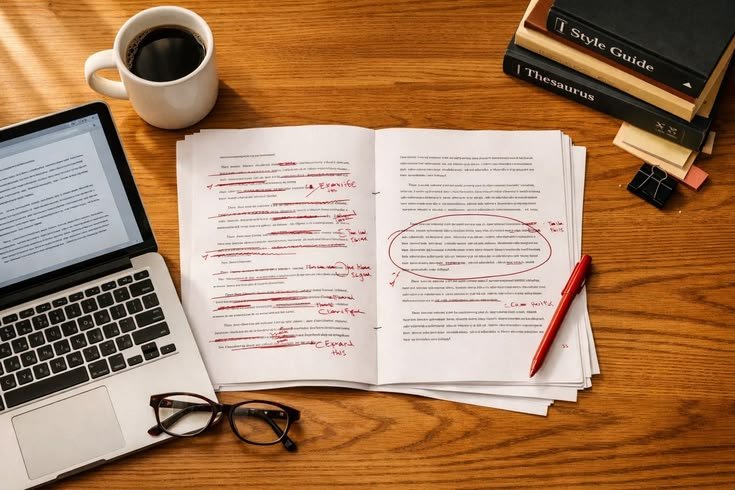
Developmental Editing vs. Copyediting vs. Proofreading: What Does Your Book Need?
- INK Publisher
- November 18, 2026
- Editing
- 0 Comments
Introduction: Not All Editing Services Are the Same
Understanding developmental editing vs copyediting vs proofreading helps you identify the kind of support your manuscript needs before publication.
Understanding developmental editing vs copyediting vs proofreading helps you identify the kind of support your manuscript needs before publication. When first-time authors begin researching professional publishing services, they often encounter terms that sound similar: developmental editing, line editing, copyediting, proofreading, and editorial assessment.
These terms describe different kinds of editorial work. Understanding the distinctions is important because choosing the wrong service at the wrong time can create unnecessary expense and frustration.
For example, proofreading a manuscript before major chapters are rewritten may mean paying to correct material that will later be removed. Similarly, a manuscript may contain grammatically accurate sentences while still having serious problems with plot, organization, or clarity. Professional editing should address the actual needs of the book.
At INK Publisher, we believe authors benefit from understanding the editorial process before preparing their manuscripts for publication. This guide explains the major editing stages, the problems they solve, and how to determine which service your book may need.
What Is Developmental Editing?
Developmental editing focuses on the manuscript as a complete work. Rather than concentrating primarily on individual sentences, the editor evaluates the book’s structure, organization, purpose, and overall effectiveness.
For fiction, developmental editing may examine plot development, character motivation, pacing, conflict and tension, narrative perspective, worldbuilding, the relationship between scenes, and the effectiveness of the ending.
For nonfiction, developmental editing often examines the book’s central argument, chapter organization, logical progression, audience relevance, clarity of explanations, supporting examples, repetition, and missing information.
For memoir, the editor may evaluate narrative focus, thematic development, pacing, and the balance between scenes and reflection.
When Do You Need Developmental Editing?
Consider this service when the manuscript feels disorganized, the plot has significant gaps, or readers struggle to understand the book’s direction. It can also be valuable after completing an early draft and before beginning intensive sentence-level editing.
What Is an Editorial Assessment?
An editorial assessment is related to developmental editing but usually has a different scope. In an assessment, an editor reviews the manuscript and provides an evaluation of its major strengths, weaknesses, and revision priorities. The feedback may be delivered through an editorial letter rather than extensive edits throughout the document.
An assessment can help authors understand the manuscript’s overall condition before commissioning more detailed editorial work. For example, an editor may identify that a nonfiction book needs stronger chapter organization, more practical examples, and clearer audience positioning. The author can use those findings to prepare a revision plan.
An editorial assessment may be particularly useful for writers who are uncertain about their next step. However, the exact deliverables vary by provider and should be confirmed before beginning.
What Is Line Editing?
Line editing focuses on the quality and effectiveness of prose. The editor examines how ideas are expressed at the sentence and paragraph level. Typical concerns include word choice, sentence rhythm, clarity, tone, transitions, unnecessary repetition, awkward phrasing, and narrative flow.
Line editing can be particularly valuable when the manuscript’s structure is sound but the writing feels uneven.
Example of Line Editing
Original: “Due to the fact that the weather conditions were becoming increasingly unfavorable, the members of the group made the decision to discontinue their journey.”
Possible revision: “As the weather worsened, the group decided to turn back.”
The revised sentence communicates the same essential information more directly. However, shorter wording is not always automatically better. A line editor should consider the author’s voice and the intended tone. Literary prose, dialogue, and reflective writing may intentionally use different rhythms.
What Is Copyediting?
Copyediting focuses on language accuracy and consistency. A copyeditor checks grammar, punctuation, spelling, usage, and adherence to an appropriate style. They may also address minor ambiguities and internal inconsistencies.
Common copyediting tasks include correcting punctuation, standardizing capitalization, checking subject-verb agreement, maintaining consistent spelling conventions, identifying inconsistent terminology, reviewing hyphenation, checking basic internal details, and flagging potentially unclear statements.
For example, if an author alternates between “e-mail” and “email,” the copyeditor may standardize usage. If a fictional character’s name appears in two different spellings, the inconsistency may be flagged. Many copyeditors also use a style sheet to record editorial decisions.
What Copyediting Does Not Automatically Include
Copyediting is not necessarily comprehensive fact-checking. It does not usually involve rewriting an entire plot or developing a nonfiction argument from the beginning. Some providers combine line editing and copyediting, but authors should confirm the actual scope.
What Is Proofreading?
Proofreading is generally the final editorial quality check before publication. It focuses on remaining errors in material that has already been edited and prepared for its final form.
Proofreaders may identify misspelled words, missing punctuation, repeated or omitted words, inconsistent headings, formatting-related text errors, incorrect page references, unexpected line breaks, and typographical mistakes introduced during production.
A proofreader is not usually responsible for extensive manuscript rewriting. At this stage, large content changes can disrupt the book’s layout and create additional errors.
Example of Proofreading
Suppose a book contains the sentence: “She returned to the the house before sunset.” A proofreader should identify the duplicated word.
They may also notice that a chapter heading has an inconsistent style or that a page reference needs correction. These details matter because they affect the professionalism of the finished product.
Editing vs. Proofreading: Why the Order Matters
Consider an author who has completed a 70,000-word novel. The manuscript contains an unnecessary subplot, inconsistent character motivations, and an ending that feels rushed.
If the author begins with proofreading, the proofreader may correct small errors while leaving the larger narrative problems unresolved. Later, the author may need to rewrite thousands of words. The original proofreading work becomes partly obsolete.
A more effective sequence may involve revising the manuscript independently, obtaining developmental feedback, completing substantive revisions, performing line editing where needed, completing copyediting, formatting the book, and proofreading the final version.
This is a common workflow, not a rigid requirement for every project. Different manuscripts and publishing arrangements may involve different combinations of services.
Comparison of Major Editing Services
| Service | Main Focus | Typical Timing |
| Editorial assessment | Overall strengths and weaknesses | Early or revised draft |
| Developmental editing | Structure, story, argument, organization | Before detailed language editing |
| Line editing | Expression, tone, clarity, rhythm | After structural revisions |
| Copyediting | Grammar, consistency, usage, mechanics | When content is stable |
| Proofreading | Remaining errors in final text | Near publication |
The most effective service is the one that addresses your manuscript’s current needs.
How to Choose the Right Editing Service
Begin by evaluating your manuscript honestly. If readers find the story confusing, investigate developmental editing. If the structure is strong but sentences feel awkward, consider line editing.
If the manuscript reads well but contains grammatical inconsistencies, copyediting may be appropriate. If the final book has already been formatted and needs a last quality check, proofreading may be the correct stage.
When uncertain, ask for an editorial evaluation or a sample edit. A sample can help you understand the editor’s approach and determine whether their feedback matches your expectations.
Questions to Ask an Editor Before Hiring
Ask about the exact services included. Will the editor provide comments, tracked changes, or an editorial letter? Are revisions performed directly in the manuscript? Does the service include a follow-up conversation, and how will disagreements be handled?
Ask whether the editor has experience in your genre, what the expected timeline is, and whether you will receive a style sheet. Confirm whether the service includes fact-checking or permissions review.
Never assume that the phrase “complete editing” has a universal definition. A detailed scope of work helps prevent misunderstandings.
Why Professional Editing Should Preserve the Author’s Voice
Editing should improve communication without unnecessarily replacing the author’s style. A romance novelist, business executive, memoirist, and children’s author will naturally use different language. An editor should recognize these differences.
The purpose is not to make every manuscript sound identical. It is to strengthen clarity, consistency, and readability while supporting the author’s intended expression.
Authors should review changes carefully and understand significant recommendations. Editorial collaboration works best when both parties communicate respectfully and focus on improving the manuscript.
Frequently Asked Questions
Do all books need developmental editing?
Not necessarily. The need depends on the manuscript’s structure and condition. Some books may benefit more from an editorial assessment or other targeted support.
Can one editor perform multiple services?
Yes. Some professionals offer more than one type of editing. The scope, timing, and deliverables should still be clearly defined.
Can proofreading replace copyediting?
No. Proofreading is not intended to resolve the full range of language and consistency issues addressed during copyediting.
Conclusion: Choose Editing Based on What Your Manuscript Actually Needs
Every editing stage serves a different purpose. Developmental editing strengthens the complete book, line editing improves expression, copyediting establishes language accuracy and consistency, and proofreading helps catch remaining errors before publication.
Understanding these distinctions allows authors to make informed decisions and prepare their manuscripts more effectively. For a broader view of the writing and publishing process, explore our first-time author roadmap.
Give your manuscript the editorial attention it needs.
Explore professional editing and publishing preparation through INK Publisher at https://inkpublisher.com

